
Like this post? Help us by sharing it!

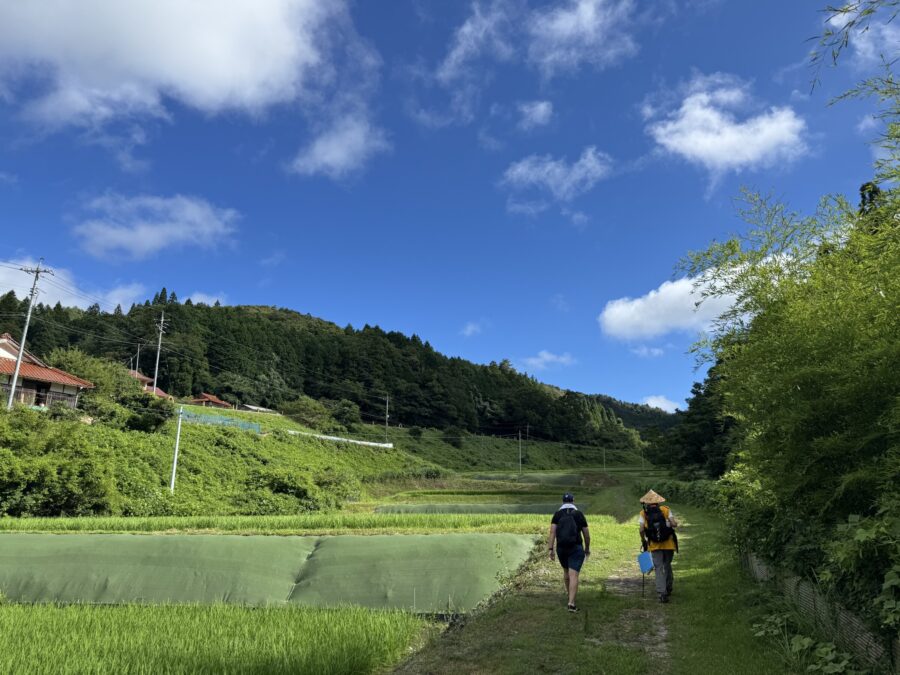
The Chūgoku region’s name roughly translates as ‘middle country’. While Tsuwano, Hagi, and Nagato Yumoto Onsen sit within this area, there’s nothing average about this western corner of Honshu.
This is a place where you can walk through hundreds of red torii gates with no one behind you, navigate streets with the same maps samurai used, dip your toes in a foot bath onsen, yukata robe on, before ordering a cocktail looking out across the Otozure River.
It feels a world away from Kyoto or Tokyo, yet it’s surprisingly easy to reach. Yamaguchi City, the region’s gateway, is just over two hours from Kyoto. And despite that, Tsuwano, Hagi and Nagato Yumoto Onsen remain under visited, under loved and underestimated.
One of Japan’s least populated corners, it’s also one of its most culturally rich, spacious and welcoming. People are genuinely pleased that you’ve made the (small) effort to come.
Tsuwano: echoes of samurai and a festive spirit
Unlike other traditional towns further east, you pretty much have the place to yourself in Tsuwano, in Shimane prefecture.
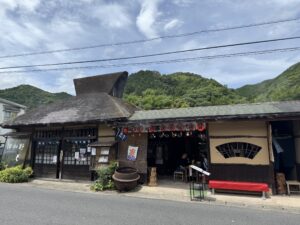
Walk down the merchant street, Honmachi Dori, towards the Tsuwano River. Pop into the traditional incense shop that served samurai hundreds of years ago, before getting a drip coffee from a modern café just down the street. You might not meet a fellow tourist, but a sake brewery owner may invite you in for a tasting (we recommend you say yes).
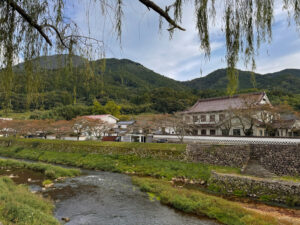
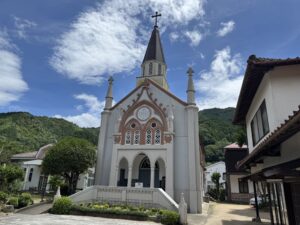
Continue onto Tonomachi Dori, with its whitewashed samurai district walls and canals full of orange koi carp. Step inside Tsuwano Catholic Church and you’ll see it’s special for a very Japanese twist – tatami mats for pews.
“A guide will tell you things you didn’t even know to look for, beyond the town centre.” Says Japan specialist, Amy, who took a morning tour.
“We walked the peaceful mountain passes together as he explained how to spot wild tea and why you don’t see many pine trees (thanks to an invasive beetle).”
“Back in town, he showed the Hyakkeizu paintings from the Edo era, matching the streets and scenes we were walking through today to those on pages. In places, they were uncannily similar.”
With so few people, and such evident links back to the past, Tsuwano can feel otherworldly. Travel writer Paul Bloomfield noted the same sensation:
“On more than one occasion I had a deliciously hairs-standing-on-neck feeling that some kind of spirit, wraith, echo was lurking at my shoulder.”
Read more about Paul Bloomfield’s West Honshu trip
It’s a feeling of peaceful solitude that’s hard to find in Japan’s more famous destinations.
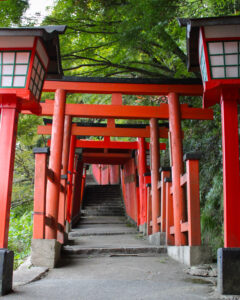
Follow the tunnel of torii gates up to Taikodani Inari Jinja Shrine, snaking up and through the forests. It’s like Kyoto’s Fushimi Inari Taisha – just without all the people.
Japan specialist Will, recently made the pilgrimage himself.
“The smell of incense drifted through the summer air, cicadas buzzed and I felt deep out in the sticks of Japan. It was a moment just for me.”
Timing his trip for summer meant Will was just in time for Tsuwano’s Kagura celebration – part of the annual heron festival. Loud, lively and a little unexpected.
“It was unlike anything I’ve ever experienced in Japan. Performers enacted a battle between a local farmer, samurai, and invading lions and wolves – with children dressed up in lion onesies. Zaima-san, our guide, explained everything and I was soon getting involved myself – dressed in a costume stitched in shiny gold, feathers and tassels. I felt very much part of the community spirit that evening.”
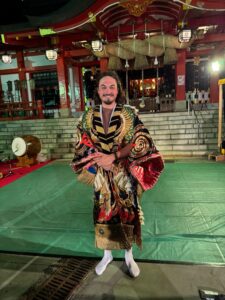
Festivals are a core part of this otherwise quiet town. In April, there’s the Yabusame horseback archery festival. Once performed as a military exercise and considered entertainment for the Shinto gods, precision mattered. And, historically, where performance wasn’t up to scratch, consequences were severe – some riders committing seppuku, ritual suicide. Today, it’s (thankfully) a lot more relaxed, set beneath the flowering cherry blossoms along Japan’s oldest Yabusame riding grounds.
Hagi: the ‘roofless museum’ with a rebellious streak.
Hagi doesn’t have a direct train line – getting here usually involves a local bus from Tsuwano, crossing the border into Yamaguchi prefecture.
“The bus journey through Yamaguchi to Hagi felt like something out of a Ghibli film.” says Will, who took the route himself.
“Rows of empty seats, trundling along a road with barely any other cars on, abandoned homes and towns along the way. If you want that feeling of being the only tourist in a place, this is where you can get it.”
It’s a route still unfamiliar for tourism, and you may be asked, politely, “what are you doing here?”. And the answer, for many, starts with history.
Hagi is so well-preserved, and so important in Japan’s evolution, that it is affectionately known as a ‘roofless museum’. The old, merchant quarter can still be navigated with maps drawn in the samurai era – you can pick these up from the tourist information centre.
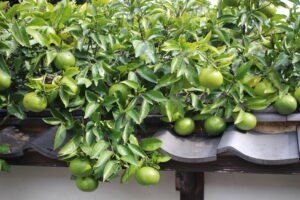
While there’s a bit of a hub around the harbour and in the modern, post-war area, residential streets are quiet, with vegetable gardens stretching into fields. Hire a bike and roll along the jokamachi (castle city) streets, alongside white samurai walls and beneath natsumikan trees heavy with citrus fruit. You can even cycle through Hagi Castle ruins, a symbol of the city’s power under the Edo-period ruling Mori clan. Today, it’s also famous for an altogether gentler reason – it’s a fantastic, uncrowded spot to see the spring blossom.
Hagi’s influence carried into the Meiji Restoration. In 1863, five young local samurai slipped out of Japan to study in London, at a time when leaving the country was illegal (sakoku). They later became known as the Chōshū Five – and their overseas education helped steer Japan into the modern era. One, Itō Hirobumi, became Japan’s first Prime Minister; another, Inoue Kaoru, became its first Foreign Minister.
You can still have a nose around where Ito Hirobumi went to school, studying directly under the teacher and intellectual pioneer, Yoshida Shoin. A tiny building, just eight tatami mats with a big impact on Japanese modern history, now a UNESCO World Heritage site. Nearby, Shoin Shrine honours Shōin, and Meirin Gakusha, once Japan’s largest wooden schoolhouse, is where the Mori clan’s children were educated.
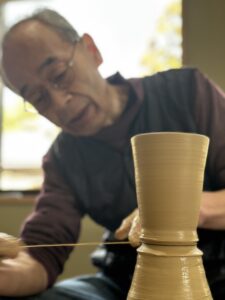
It’s a town with a rebellious streak – and that extends into its crafts. Developed over 400 years ago, Hagi-yaki pottery is made deliberately imperfect. A notched chip in the base made it impossible to gift to the ruling Mori clan, so it could then be sold at market. The oldest pieces have been declared National Treasures of Japan. Today, you can throw down on the pottery wheel yourself. You don’t need to be an expert – imperfections are embraced, after all.
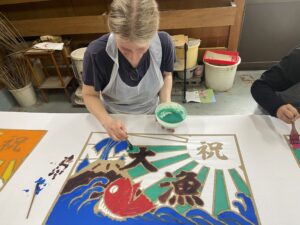
For something a little less fragile and a bit more flamboyant, there’s Tairyo-bata – vibrant fishing boat flags that symbolise a good catch. Decorated in bright post-box reds, deep greens and sunshine yellows with sand flicked on, these auspicious, maritime designs have been dyed this way since the Edo period.
Travel writer, Kate Crockett, spent a fun afternoon dying her own flag, in Sora-san’s 100-year-old workshop:
“I knew Hagi for its pottery, but I really had no idea about the importance of the sea to this city. The Iwakawa family’s vibrant, hand-made fisherman’s flags (Tairyo-bata) are still used on the Hagi fishing fleet. The process was very simple, fun and surprisingly meditative. The finished flag they sent on to my next hotel is beautiful.”
Nagato Yumoto Onsen: onsen, cocktails and yukata
Half an hour by car from Hagi, Nagato Yumoto Onsen is the place to wind down your trip, put on yukata robes, and stroll quietly down to the onsen baths.
There is very little to do here, and that’s its attraction – a small onsen town built around the river. Quieter even than Tsuwano or Hagi, it’s very rural, or as the Japanese say, cho inaka.
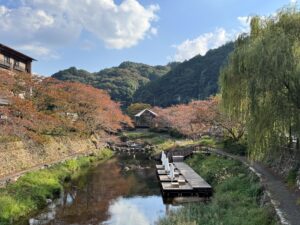
And yet it’s rural in a way that is easy to navigate, and has a real spa-break feel. You may meet a handful of foreign tourists here, but it’s more likely you’ll meet Japanese holidaymakers, having a break from the city.
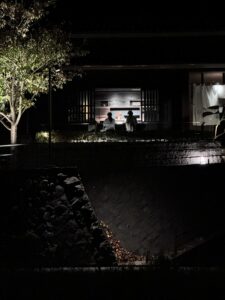
The riverside lights up at night. Decking extends down to the river, for evening drinks and food. And there’s even a touch of nightlife – a bar where you can get an excellent whisky cocktail, and watch the sun go down.
READ MORE: The places in-between: Nagoya
A true sense of inaka
If you’re willing to go beyond the main tourist routes and catch a bus or two, West Honshu rewards you with a true sense of inaka – that middle of nowhere feeling that is hard to capture when travelling through Japan on the established tourist routes.
Tsuwano, Hagi and Nagato Yumoto Onsen may be in one of Japan’s least populated regions, but will offer one of the warmest welcomes.
“This region has some of the nicest people”, says Japan specialist and ex-Yamaguchi resident Brett.
“People are genuinely thrilled that you have visited their corner of Japan. Choose here, and they’ll roll out the red carpet for you.”
If you want to extend your trip to Honshu’s westerly reaches, take our West Honshu Wonders itinerary as inspiration.